Dec 1
‘Wicked: For Good’ – Second Oz musical film neither flies nor defies gravity
Brian Bromberger READ TIME: 1 MIN.
If you were worried about annoying sing-alongs interrupting your movie-watching from last year’s “Wicked,” rest assure you have nothing to fear in “Wicked: For Good,” (Universal Pictures) as none of the songs will stick in your head or bear repeating in any format. Sadly, the music is the least of this film’s problems, though two new songs written by the original “Wicked” gay composer Stephen Schwartz, one for Elphaba (“There’s No Place Like Home”) and for Glinda (“The Girl in the Bubble”), are both lackluster, though the latter is less unsatisfying.
While reviews are mixed overall, the negative ones have been blistering and unfair. “Wicked: For Good” is not nearly as good as “Wicked,” but neither is it a disaster. Many of its issues go back to the original stage production that dealt with a darker, grimmer denouement with less whimsy and enchantment.
Both the original stage musical and the “Wizard of Oz” are creative albatrosses hemming in this film. It will still be a box office hit, but as art it doesn’t quite succeed, though certainly not due to its two superstar leads who do their very best despite material that ultimately lets them down.
Behind the curtain
“Wicked” would have worked much better as a single 3/3.5 hour film, especially since recent hits such as “Oppenheimer” and “The Brutalist” were very long, proving audiences are willing to sit through terrific, challenging subject matter. Even though “Wicked: For Good” clocks in at a brisker 2 ¼ hours as opposed to “Wicked’s” 2 ¾ run time, it feels longer due to the bloat, less real narrative, uneven pacing (lacking the dynamism of “Wicked”), and overall lack of depth.
It’s a series of below-par musical numbers strung together which might explain why the film lacks any narrative cohesion, with dialogue serving mainly as filler in between songs. The film comes across as a greedy commodified studio cash grab, meant to dominate two holiday seasons, which might explain the film’s hollow core.
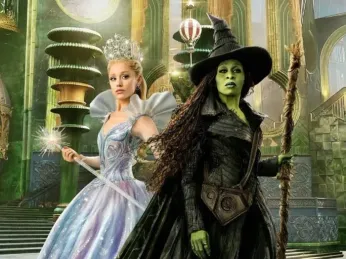
There’s no brief recap of “Wicked,” to refamiliarize us with its plot, though it’s a few years later. Glinda (Ariana Grande), the showpiece figurehead of Oz, appears to be enjoying the fame, adulation and perks of being a pawn for both the Wizard (Jeff Goldblum, his lousy singing offset by his oily charm) and Madame Morrible (Michelle Yeoh, in a one-dimensional miscast cliché performance).
The Wizard is set up as a Trumpian fascist whose evil could be revealed before a crowd and people would still love him. Elphaba continues to expose the Wizard for his corruption and enslavement of the animal citizens of Oz, and his poor treatment of the Munchkins. Through Morrible’s fearmongering publicity campaign, she’s everyone’s favorite villain, the true Wicked Witch of the West, a scapegoat for the Wizard’s authoritarian rule.
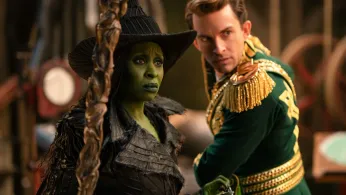
To maintain her fairy tale princess façade, Glinda is pushed into marrying in a grand spectacle wedding to the insipid but gorgeous Prince Fiyero (Jonathan Bailey, and yes, he more than deserves his title as People Magazine’s Sexiest Man Alive), who is now Captain of the Wizard’s Guard.
But Fiyero is secretly in love with Elphaba. In one of the film’s best scenes, Bailey takes off his shirt for a meh love ballad in Elphaba’s secret forest hideaway. While Bailey looks absolutely stunning in this film (even sexier than in “Wicked”), dramatically he has far less to do. In “Wicked” he was charming, here he seems befuddled. The unconvincing love triangle rings false, but kudos for Bailey’s seductive glances and one of the best removal of suspenders in cinema history. Once his duplicity to Glinda is exposed, Elphaba saves him from capture, but why he turns into the Scarecrow remains a mystery, though I can’t say I really cared.
Drop a house on her
Dorothy and her traveling companions are kept to a minimum, almost cameo appearances. We never even see Dorothy’s face and her friends are mostly in shadow. We view the same “Wizard of Oz” events from other perspectives, such as Elphaba’s devastation when Madame Morrible summons a hurricane in Kansas that results in Dorothy’s house falling on and killing her sister Nessarose (Marissa Boda). She had stripped the Munchkins of any rights so her Munchkin lover Boq (Ethan Slater) would cede to her beck and call.
Before her death, Nessarose implores Elphaba to use her magical powers to help her disability, which she does by enchanting her shoes so she can fly. Boq, feeling he’s no longer needed, hits on Glinda, which enrages Nessarose who accidentally turns Boq into the Tin Man. Aren’t you glad you now know his origins?
There are other “Wizard of Oz” tie-ins, but they bog down and restrict any narrative creativity that might have enlivened “Wicked: For Good.” Still, both Erivo and especially Grande are magnificent singly and together, redeeming the film.
Because of Fiyero’s rejection and overall disillusionment with pretending to be happy when she isn’t, Glinda must reevaluate her life and position in Oz, ambivalent about her political power and her concerns about Elphaba’s fate. These contrary preoccupations create an inner conflict. “Wicked” focused on the Elphaba’s self-realization and emerging self-confidence, while “Wicked: For Good” is Grande’s chance to shine; and she soars, stealing the movie, though Elphaba has her one electrifying moment, belting out the power ballad “No Good Deed,” an homage of her life as a villainess.
Heart’s desire
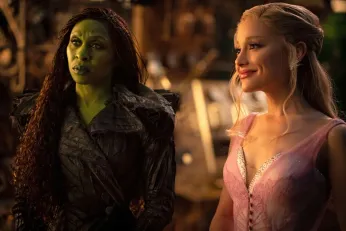
Glinda’s real love interest isn’t Fiyero but Elphaba, and their sparks outshine anything either woman does with Bailey. The film’s highlights are when Elphaba and Glinda meet together reinforcing their female friendship. Though if you were hoping the sexual chemistry implied in “Wicked,” will burst out here, you will be disappointed.
Still, their duet “For Good” is easily the movie’s showstopper. Regrettably, there aren’t enough scenes with the two women together. Because they generate sparks when they interact, the film sags when they are apart.
Gay Oscar winner Paul Tazewell’s costumes are spectacular as is Nathan Crowley’s innovative production design. Yet once again, the color grading is off at times (though not as much as it was in “Wicked”) with some scenes too dim while others are too bright with lots of murkiness, so you can’t tell some of the lesser nonhuman characters from each other. The CGI effects feel hokey at times, particularly when applied to the animal figures.
For rabid fans of “Wicked” (the book, stage musical or film), nothing critical we say will dissuade you. “Wicked: For Good” is an event. If we focus on Erivo/Grande, all is good. Had both been condensed into one film, it could have been a glorious triumph, the latter’s inherent narrative weaknesses compensated by the first’s musical heights.
Instead, it’s an average mishmash held together by the pizazz of Erivo/Grande. It’s already on course to become one of 2025’s blockbusters. Yet it’s similar to Dorothy in “Wizard of Oz,” who discovers the great and terrible Wizard is all smoke and mirrors, despite its box office magic.
While it might not be ‘popular’ to say it, “Wicked For Good” feels underwhelming and a waste of the almost unlimited available resources. But with its sapphic underpinnings, drifting off into a quasi-gay fantasy is hardly the worst way to spend two + hours, so enjoy the bumpy ride.